In an increasingly competitive real estate market, developers often focus on a single question:
“How much does it cost ?”
But in a context where 96% of buyers start their property search online before even visiting a property, the real question becomes:
“How much does your communication strategy contribute to reducing sales timelines, increasing perceived value, and securing the purchasing decision ?”
This shift in thinking is not a trend.
It represents a deeper transformation: real estate communication is becoming a financial lever, not simply a cost.
Real estate development : the question is not “how much does it cost”, but “how much does it generate”
Real estate is becoming increasingly digital
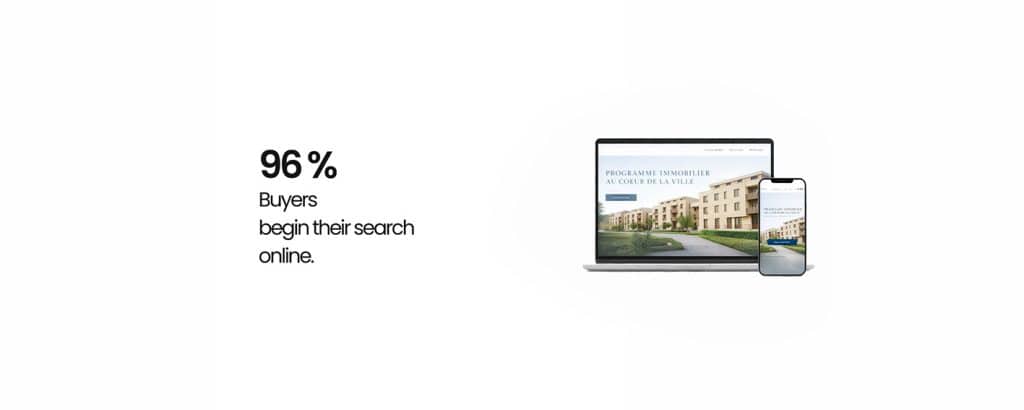
Buyers start their search online
Today, almost all buyers (96%) use online resources to begin their property search.
This means that if your project is not visible and engaging online, it simply does not exist in the eyes of the market.
In addition :
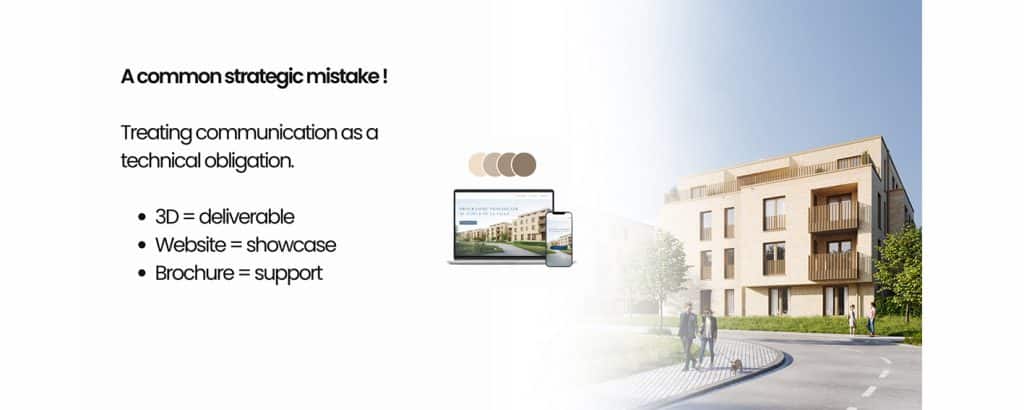
Many developers still approach communication as a formality :
The result :
This reasoning reduces the value of the project because it confuses a production tool with a commercial performance lever.
A real estate development is not a graphic project.
It is a financial asset that must be managed strategically.
Research on real estate marketing provides compelling data :
This is not marketing storytelling.
It is a measurable effect on key performance indicators.
Better visualization leads to:
✔ Higher engagement
✔ More qualified leads
✔ Shorter decision-making cycles
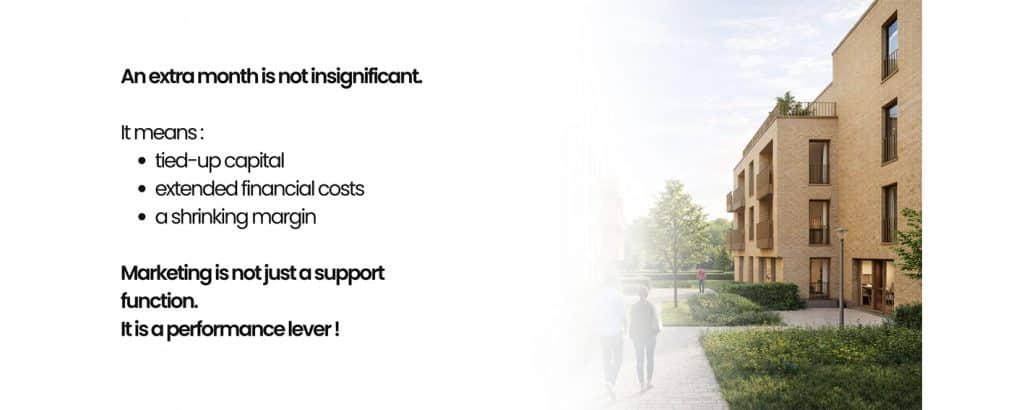
In real
estate development, every month of delay directly affects project finances.
For example, if an immersive communication strategy reduces the sales timeline by just 30%, it can reduce :
A well-executed strategy does not only generate leads.
It protects your margins.
Banks do not finance only land or construction.
They finance an asset that must be sold quickly and with minimal risk.
A project presentation that includes :
Provides clarity, builds confidence, and reduces perceived risk for financial institutions.
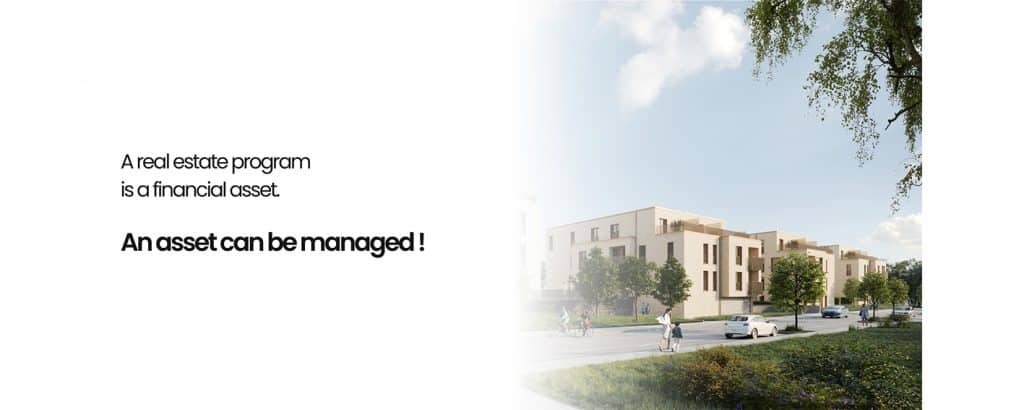
Today, a website is no longer just a catalog.
It serves to :
And with nearly 96% of buyers searching online, SEO optimization, user experience, and integrated visual tools become decisive elements.
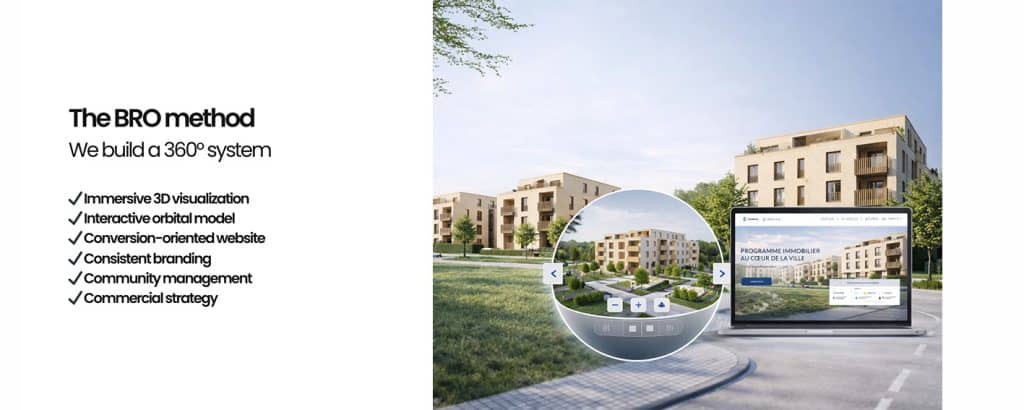
In off-plan sales (VEFA and similar models), the need for projection is critical.
A 2D floor plan is technical.
A 3D perspective is explanatory.
An immersive virtual experience is experiential.
This shift from technical explanation to experiential projection transforms :
To move from cost-based thinking to performance-based thinking, developers must analyze key metrics :
Key KPIs include :
✔ Average decision-making time
✔ Number of qualified leads
✔ Conversion rate
✔ Time required to reach 50% pre-sales
✔ Cost per lead vs. cost per acquisition
These indicators provide a clear view of real impact rather than subjective impressions.
The digitalization of the real estate market is not a temporary trend.
It is a structural transformation.
An effective omnichannel strategy integrates :
✔ SEO-optimized websites
✔ Interactive visuals
✔ Virtual tours
✔ 3D films and animations
✔ Targeted social media presence
✔ Geolocated digital advertising
When coordinated, these elements are not isolated expenses.
They become an integrated system for value generation.
The question “how much does it cost?” belongs to an outdated decision-making model.
Today, the most successful developers think in terms of value :
“What impact does each euro invested have on sales speed, lead quality, project credibility, and final margin ?”
This mindset is precisely what differentiates a graphic service provider from a strategic commercialization partner.
Are you developing a residential or mixed-use project in Luxembourg, France, Belgium, or internationally?
Let’s discuss your commercialization strategy before discussing costs.
No need to look any further,
receive all our news in your mailbox by subscribing to our Newsletter.

In real estate development, the success of a project does not depend only on architecture or design quality. It also depends on how the project is presented to potential buyers.
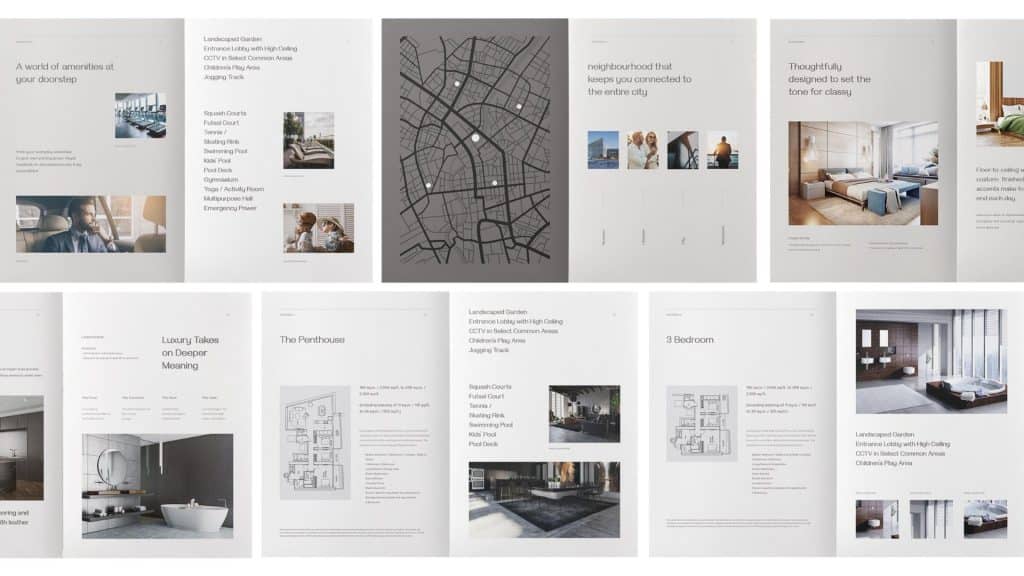
Today, developers have access to a wide range of marketing tools: floor plans, 3D renderings, brochures, websites, virtual tours and interactive models.
However, producing marketing materials is not enough.
To be truly effective, these tools must be part of a coherent strategy designed to guide decision-making.
Too many materials, not enough logic.
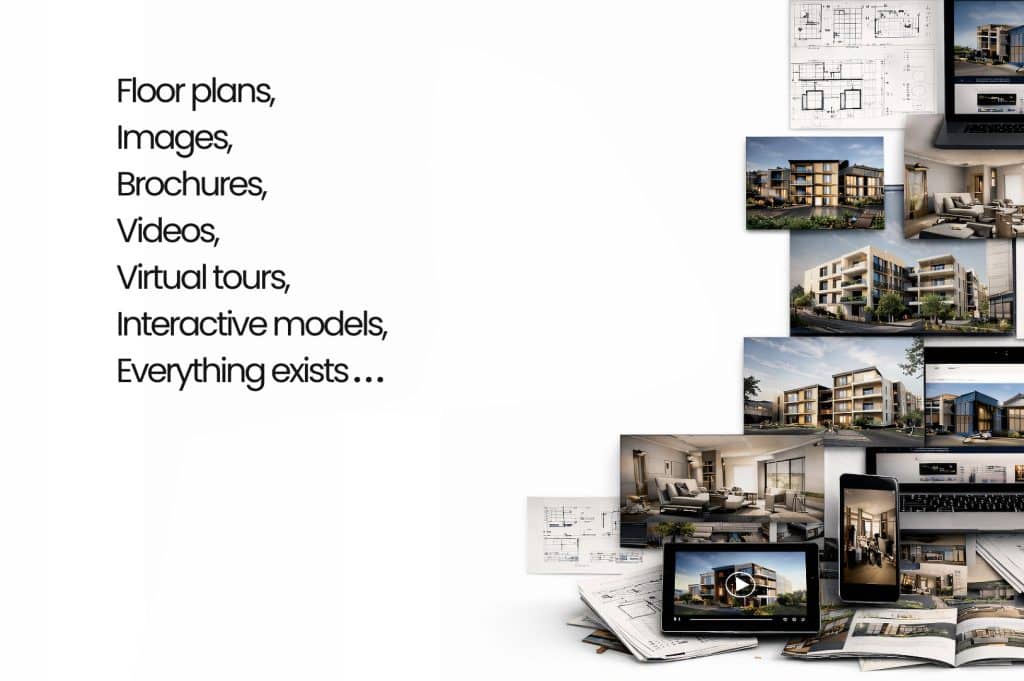
The real estate development industry has never had so many marketing tools available. Technologies have evolved dramatically: ultra-realistic 3D renderings, immersive animations, interactive configurators and advanced digital experiences.
Yet one reality remains :
The problem is not the lack of tools.
The problem is the lack of structure.
A good sales tool is not the one you add.
It is the one you place at the right moment.
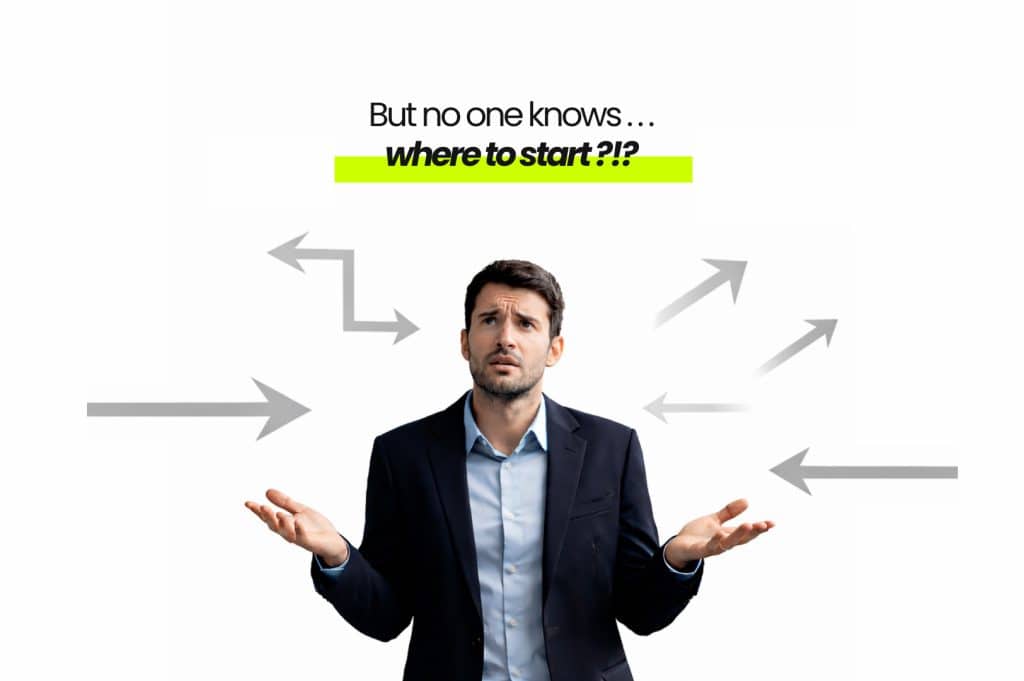
In most cases, the difficulty does not come from the project itself.
It comes from how the project is brought to market.
Here are the most common mistakes.
❌ 1. Non-Strategic Production of Marketing Materials
Developers often commission :
But without a global strategy.
As a result, each marketing material exists independently.
❌ 2. No Decision-Making Journey
A real estate buyer goes through several stages :
Most marketing tools are not designed to support these stages.
They are simply produced.
❌ 3. Information Overload
Too much information slows decision-making.
When everything is highlighted :
An excess of poorly structured marketing tools slows down sales.
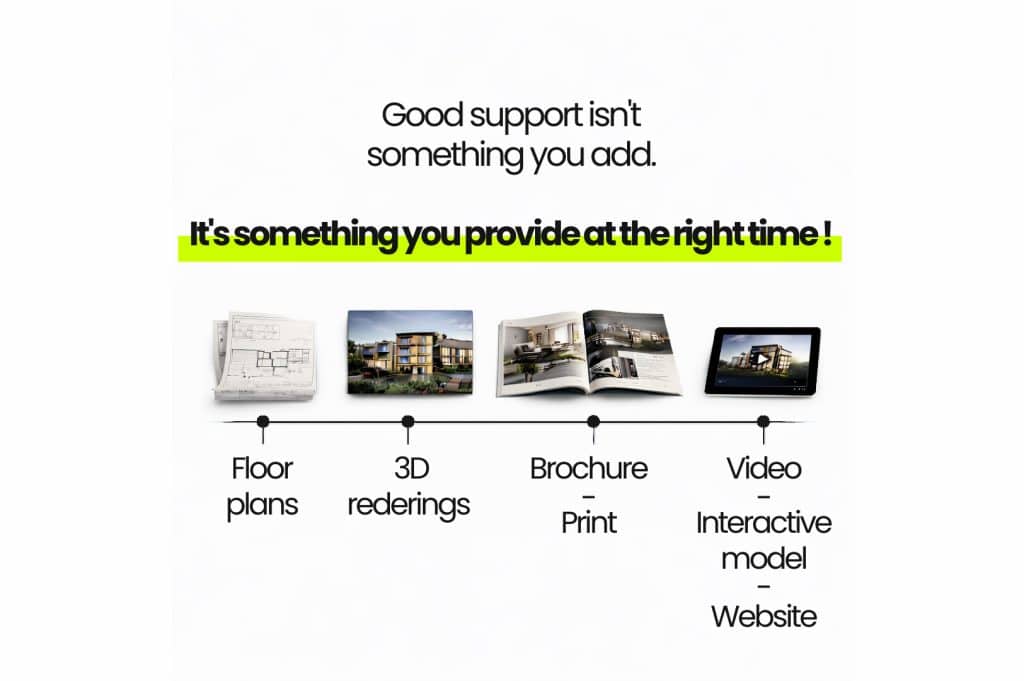
Every marketing deliverable must answer a specific question.
It is not just a visual element.
It is a decision trigger.
Floor Plans
Question :
Does this apartment fit my lifestyle ?
Architectural 3D Renderings
Question :
Can I imagine myself living here ?
The Brochure
Question :
Is this a serious and credible project ?
Interactive 3D Model / Orbital Model
Question :
Where exactly is my future apartment located ?
The Project Website
Question :
Can I quickly understand the project ?
Every marketing tool must answer a strategic question.
Otherwise, it becomes decorative.
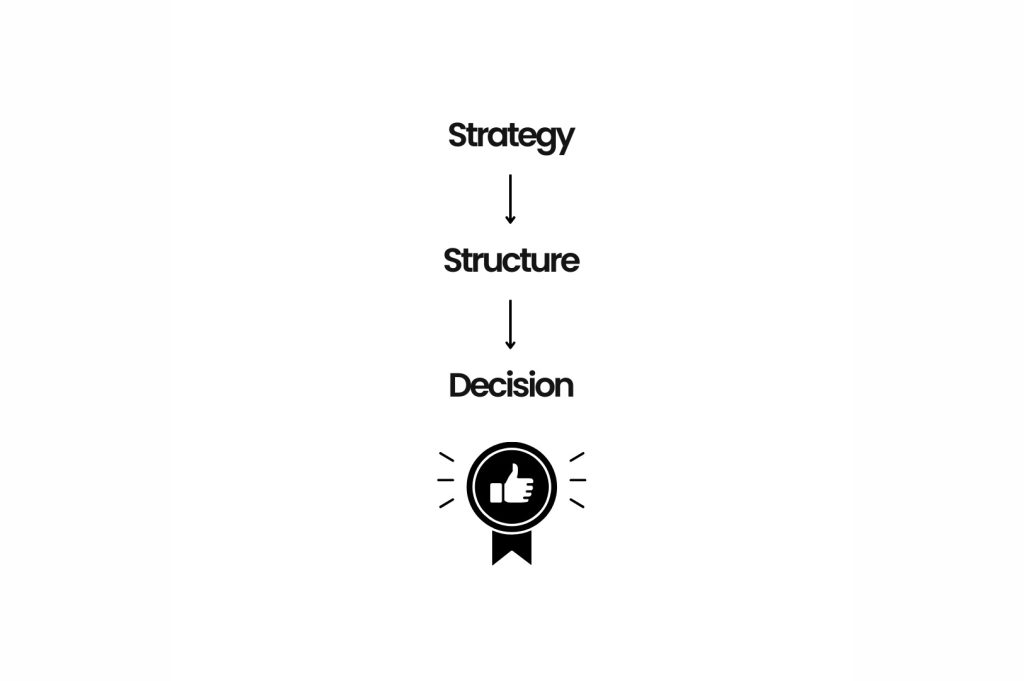
Real estate sales are not about accumulating marketing materials.
They are about building a system.
At Banana Republic Office, we follow a simple logic.
1. Strategy
Understanding :
Without strategy, production is blind.
2. Structure
Organizing marketing tools in a logical sequence :
Visibility
A good marketing tool is not the one you add.
It is the one you place at the right moment.
3. Decision
When the structure is clear :
Structure sells.
Accumulation does not.
A real estate development project involves :
Every week gained matters.
Every unit reserved strengthens the project.
A structured marketing strategy allows developers to :
✅ reduce decision time
✅ improve project understanding
✅ reassure buyers
✅ increase perceived value
✅ simplify the work of sales teams
The difference between a slow project and a successful one is not only architecture.
It is presentation.
We do not simply create visuals.
We design structured sales tools.
We create :
But most importantly :
We structure them.
Our objective is not only aesthetic.
It is commercial.
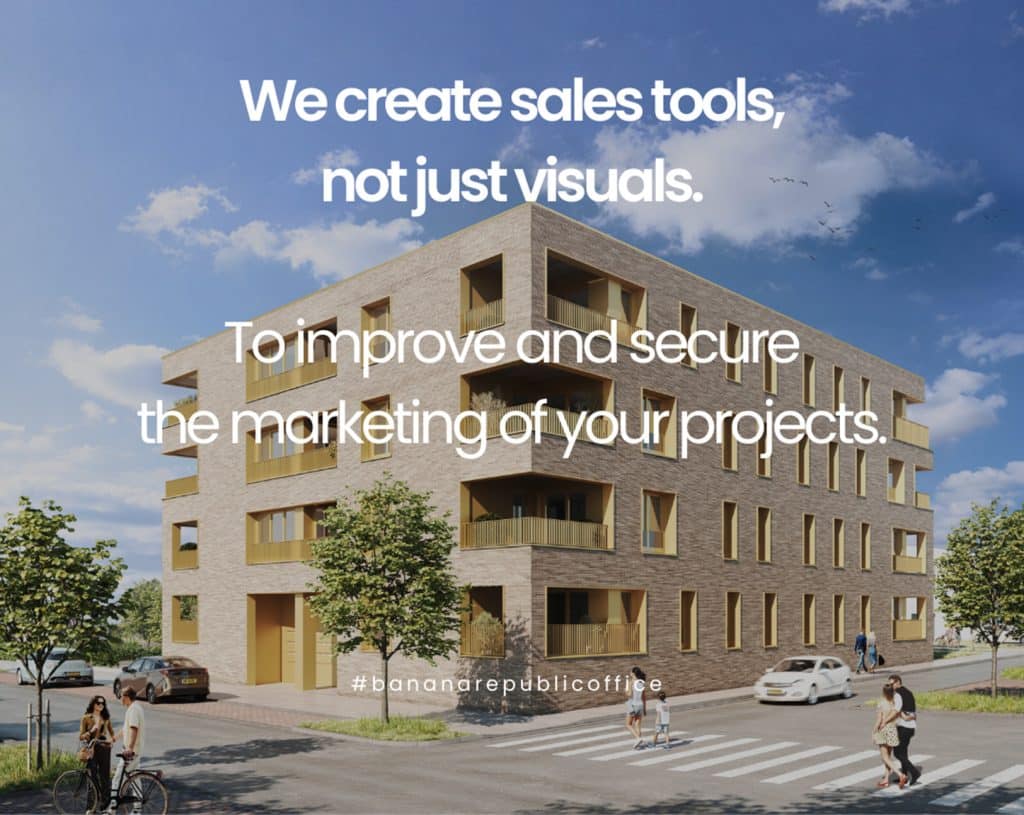
To accelerate and secure the commercialization of your real estate projects.
The market is becoming more demanding :
The developers who succeed will not be those who produce more materials.
They will be those who structure them better.
Too many materials.
Not enough logic.
Modern real estate marketing is not an addition :
At Banana Republic Office, we design marketing tools as a 360° decision system.
To improve and secure the commercialization of your projects.
No need to look any further,
receive all our news in your mailbox by subscribing to our Newsletter.
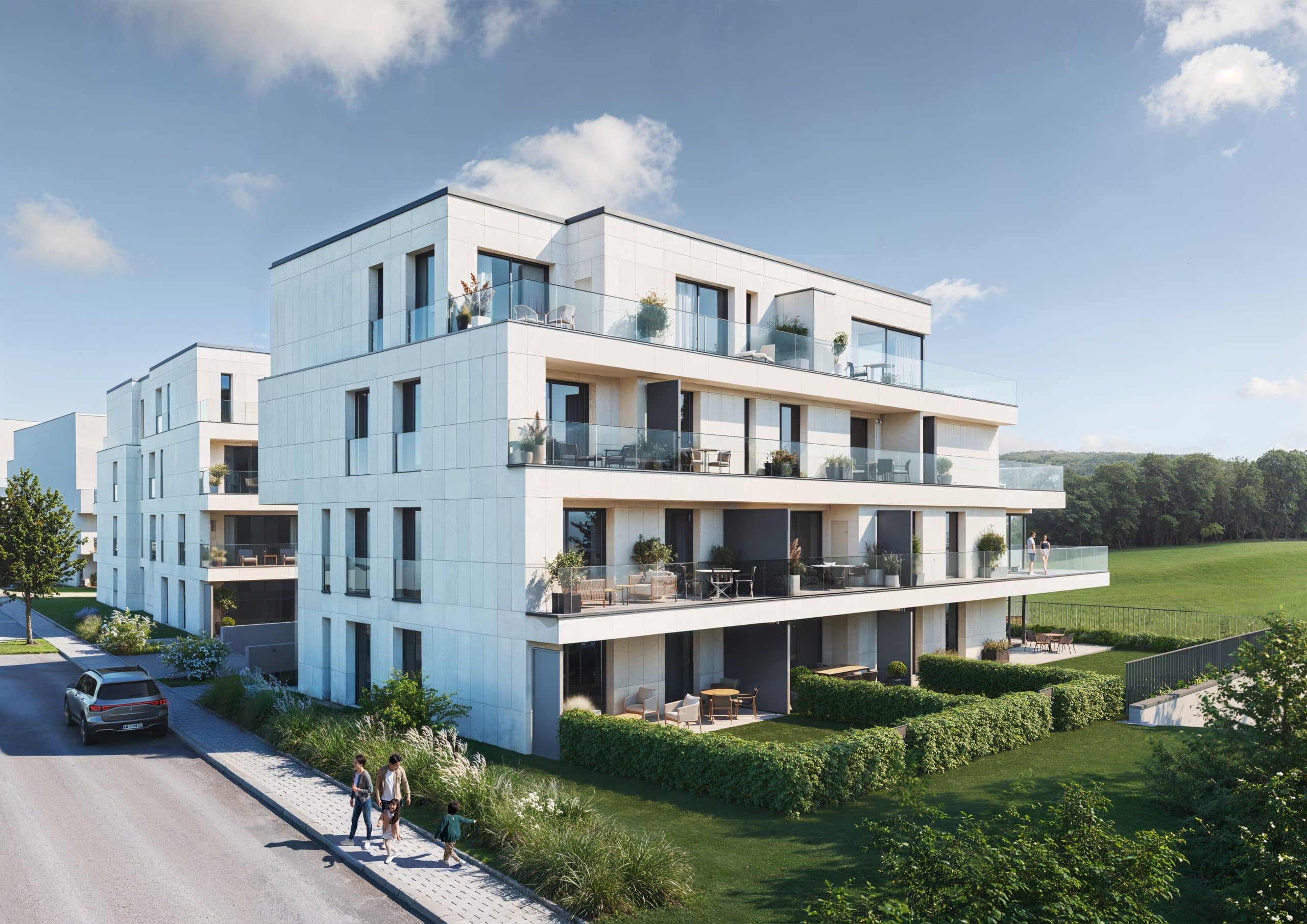
Volumes, light, photorealistic perspectives: 3D visualization has profoundly transformed real estate communication. Yet in an increasingly demanding market, simply impressing is no longer enough. An architectural image must do more than captivate : it must clarify, structure, and move decision-making forward. That is the real difference between a beautiful image… and a useful one.
A beautiful image does not move a real estate project forward
In architecture and real estate development, 3D visualization has become essential. Photorealistic renderings, spectacular perspectives, immersive animations, 3D videos… technical quality has reached an impressive level.
Yet one strategic question is often overlooked:
Is a beautiful image truly enough to move a real estate project forward ?
The answer is no.
A 3D image can impress, seduce, create a “wow” effect. But if it does not clearly explain an architectural project, it slows decision-making instead of accelerating it.
At BRO, we see real estate 3D visualization as a decision-support tool designed for property developers, architects, urban planners, real estate agents, and marketing teams.
This shift in perspective fundamentally transforms the way architectural renderings are conceived.
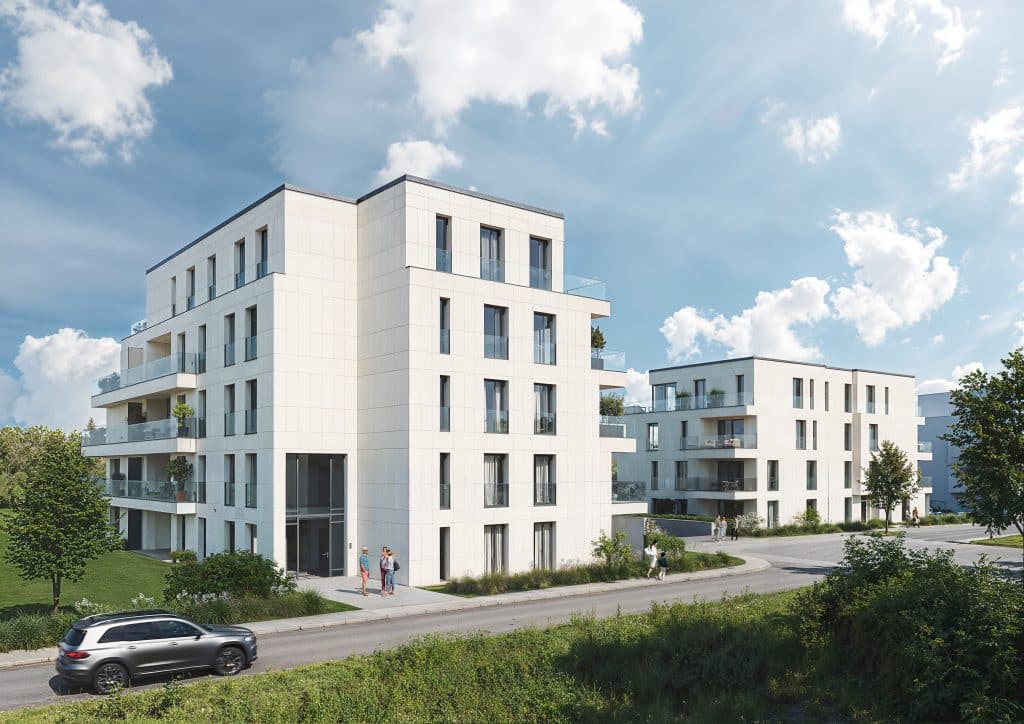
The real role of an imagine in a real estate project
In a real estate project, an image plays a role at several strategic stages :
internal project validation
For a property developer, each stage involves significant financial and time-related stakes. A delayed decision can impact :
3D visualization is therefore not just a marketing tool. It is a strategic asset.
An effective architectural 3D rendering must quickly answer fundamental questions :
If the image does not clarify these aspects, it creates uncertainty.
And in real estate, uncertainty slows decisions !
Showing a real estate project does not mean explaining it
Most real estate 3D renderings highlight :
a façade at sunset
These images are often highly aesthetic. They serve real estate communication. But they do not guarantee understanding.
A real estate agent needs clear support material to explain :
A property developer must be able to quickly validate :
volumetric coherence
High-performing 3D visualization is not simply beautiful — it structures comprehension.
There is a fundamental difference between a decorative rendering and a strategic rendering.
A decorative rendering attracts attention.
A strategic rendering facilitates decisions.
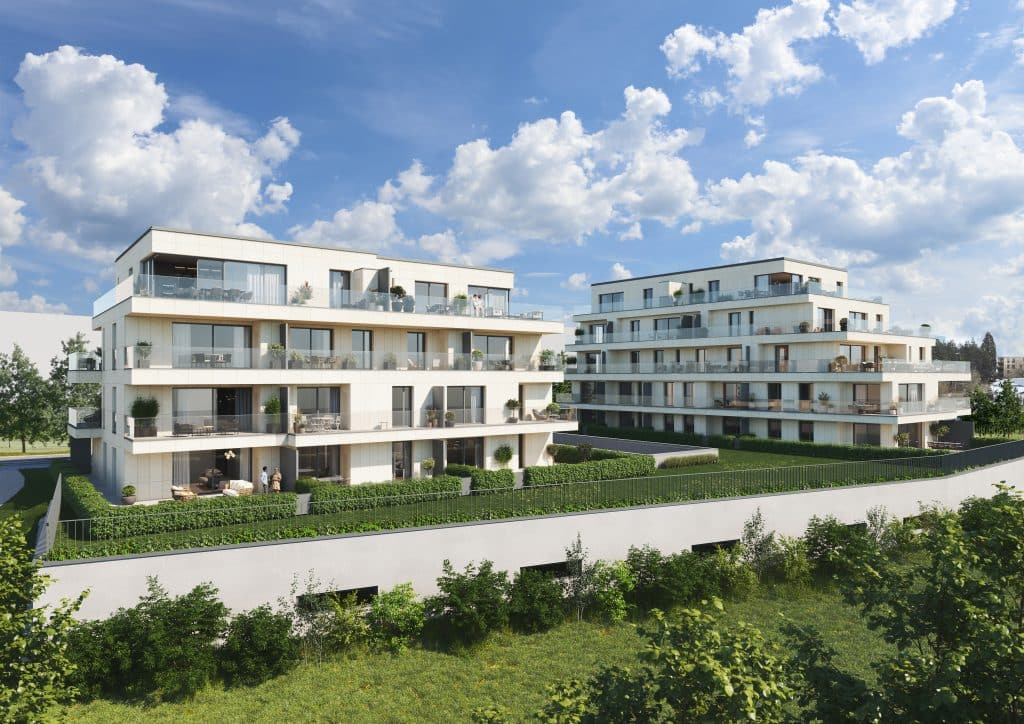
When a 3D rendering fails to fulfill its explanatory role, several consequences arise.
1. Decision-Maker Hesitation
An investment committee, developer, or financial partner does not validate a project based on aesthetic impression alone. They validate based on clear understanding.
If the image generates too many questions, it delays approval.
Every day of delay can impact :
2. Costly Revisions
A poorly oriented rendering often leads to :
repeated modifications
3D visualization should anticipate questions. Too often, it generates them.
3. Less Effective Sales Performance
In off-plan sales, the image is the primary projection tool.
A future buyer must immediately understand :
If understanding is difficult, the decision is postponed.
Real estate 3D visualization is evolving.
Today, tools allow us to go beyond static images :
brochures aligned with sales plans
At BRO, we do not simply produce 3D renderings. We design coherent visual systems.
Each image has a precise role :
to explain
An orbital model, for example, provides a global understanding of the project. It offers a dynamic reading of volumes and site integration.
Combined with a dedicated real estate website, it becomes a powerful real estate marketing tool.
For a property developer, this means :
better internal understanding
For a real estate agent :
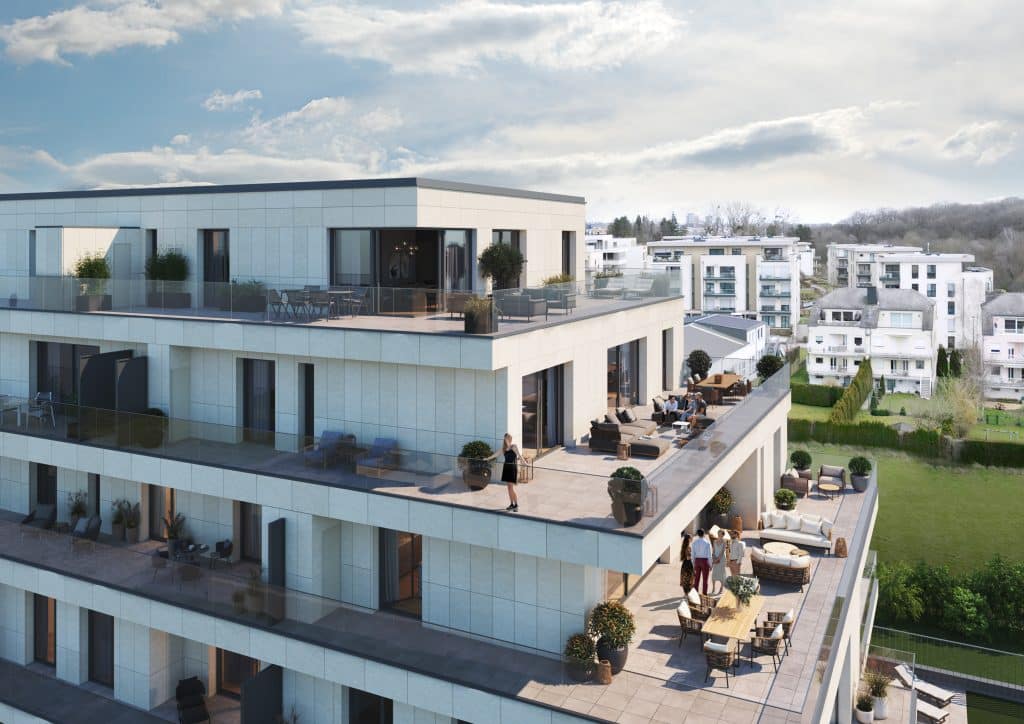
The real question is not:
“Is the 3D rendering spectacular?”
But rather:
“Is the project immediately understood ?”
A successful real estate 3D visualization :
In a competitive real estate market, performance no longer relies solely on aesthetics.
It relies on clarity.
At BRO, we develop real estate communication tools designed for professionals: property developers, architects, real estate agents, and marketing teams.
Because a project that is understood… is a project that moves forward !
At Banana Republic Office, we put all of these skills at your service. Contact us and tell us about your project — we will create the architectural rendering that best fits your needs.
No need to look any further,
receive all our news in your mailbox by subscribing to our Newsletter.
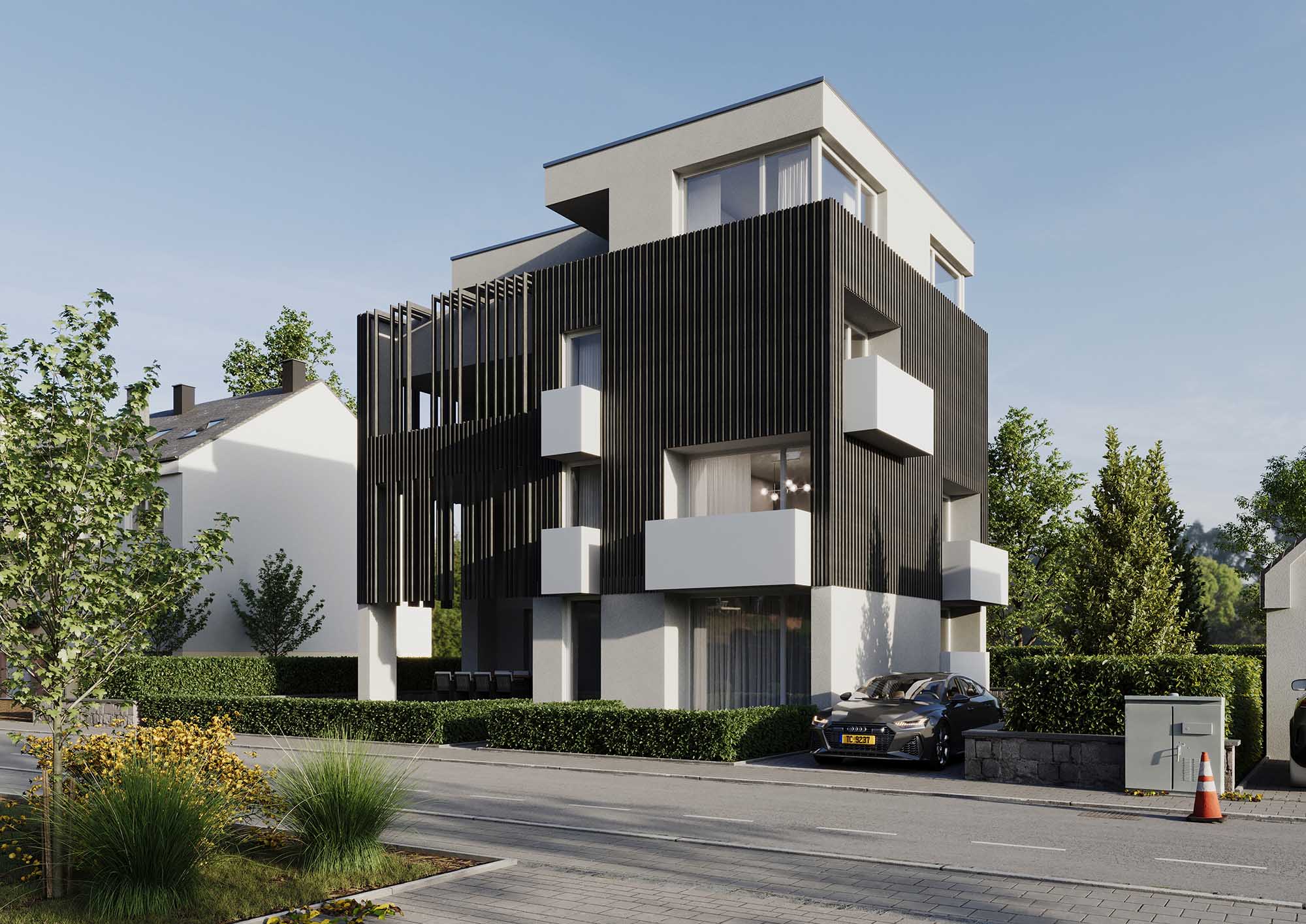
Volume, texture, light, sometimes even movement: your property projects can be brought to life with 3D architectural images. In this sector, it is essential to present projects that are sufficiently attractive to immediately capture the attention of (future) customers. 3D imaging technology provides realistic visual renderings that make it possible to visualise the project as a whole and capture all its qualities. Banana Republic Office tells you more.
In real estate, the visual presentation of a project is crucial to attracting attention and selling successfully. It’s not always easy for your customers to see themselves from a 2D plan. 3D architectural images help them to visualise their future home more clearly, and even to move into it.
3D images offer a number of advantages for enhancing your property projects:
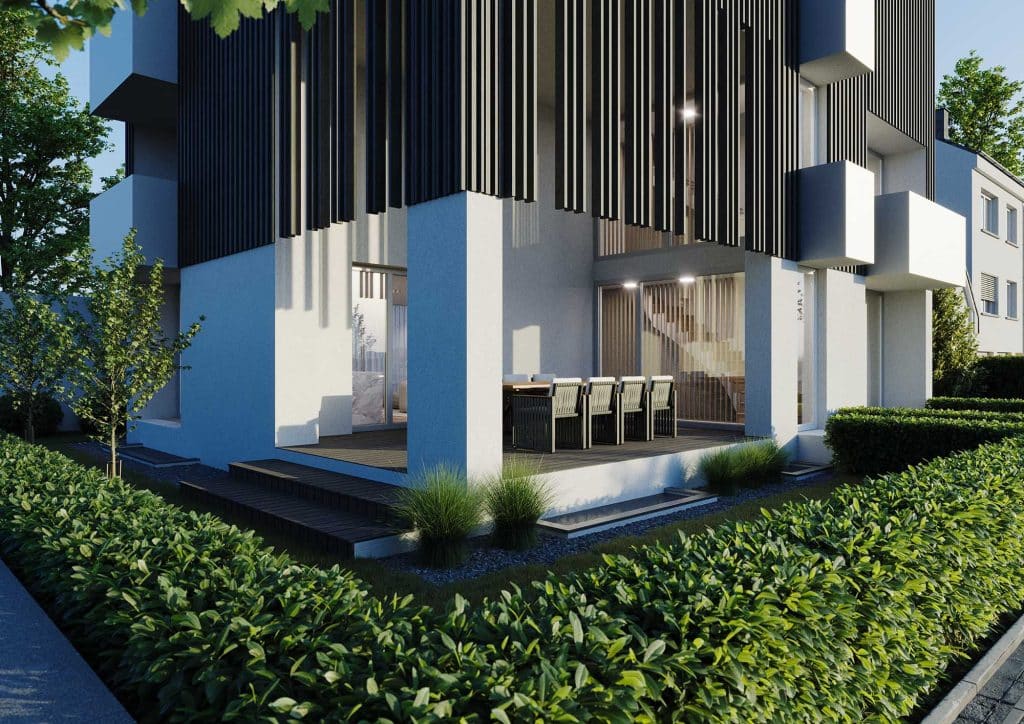
3D images are a highly effective tool for presenting your property projects, provided you get the best possible renderings. Not only do you need to know about architecture first and foremost, but you also need to know how to use specialist software, which requires a certain amount of expertise. Fortunately, you can free your mind and entrust your 3D perspective, 3D film or 3D plan project to Banana Republic Office.
We take care to provide high-resolution images of the highest quality. We vary the viewing angles to give you and your clients a better idea of the project. Lighting, materials and textures are realistic for a more lifelike rendering.
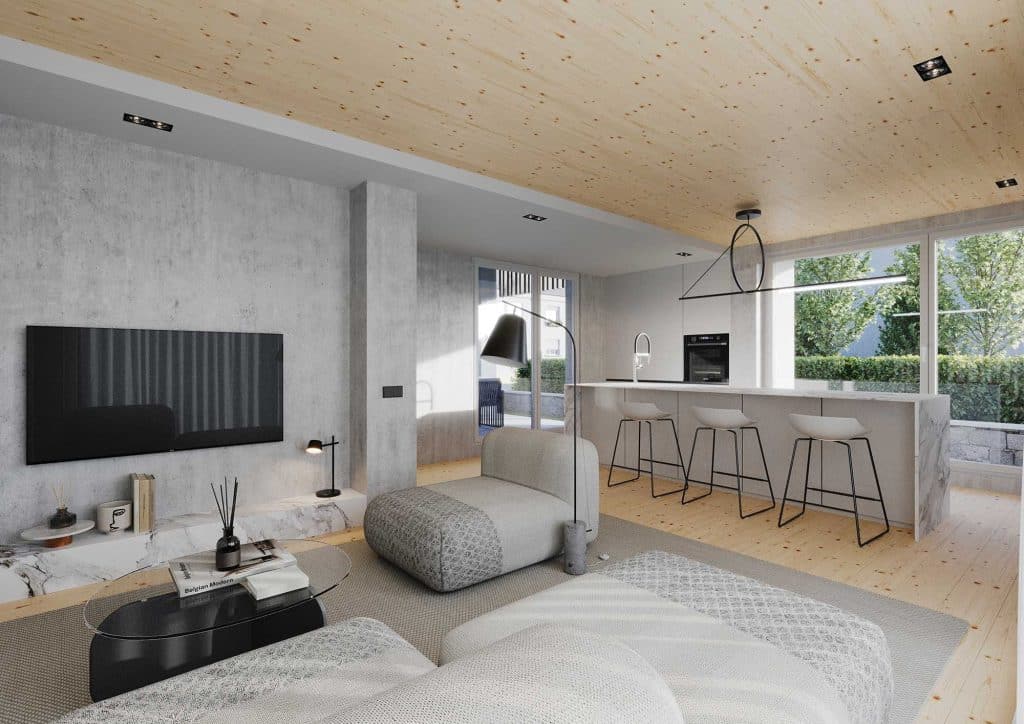
3D architectural images can be used in a variety of ways and situations. Here’s how.
3D architectural images can be used, for example, to personalise properties for sale. You can propose several variations of a space to help customers project themselves in a place that meets their desires and looks just like them.
All the rooms can be modified and enhanced according to the customer’s expectations, making it easier and quicker for them to give you their approval. The use of 3D architectural images in real estate can speed up sales.
Once again, you’ll save time ! You don’t have to wait until the end of the construction project to take photos and put the flat or house up for sale. With 3D architectural images, you can build up a portfolio right from the start of the project. You can add to it with several realistic 3D perspectives which, as we said, will attract your prospects and perhaps win over the customer straight away.
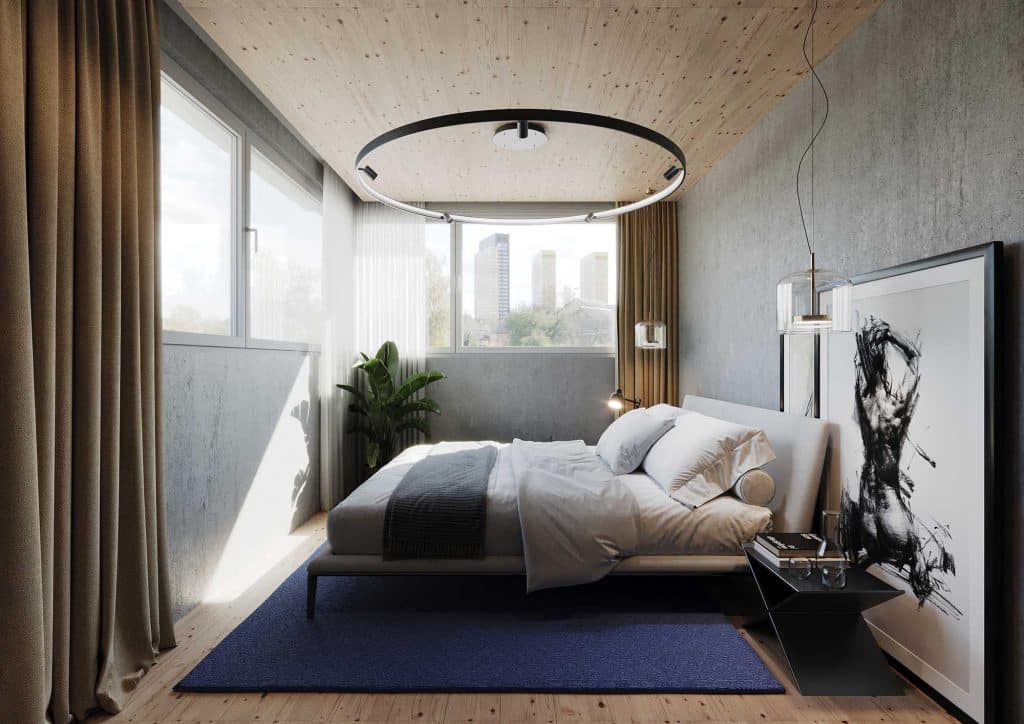
Communication and marketing in real estate are essential levers. 3D architectural images are a magnificent showcase for your company. They show your know-how, your skills, your speciality, your trademark – in short, they help to develop your brand image.
You can make the difference with 3D architectural images that highlight the quality of the services provided by the property you are selling and underline your professionalism.
The 3D creation tool allows you to check the details of your property project, such as the layout of rooms, volumes, materials, etc.
Photo or 3D image ? That’s the question your customers will ask themselves when faced with 3D creation. They’ll be able to get an accurate picture of their future living space. The 3D architectural image is a good way of turning your customers’ wishes into reality by offering them harmonious projects.
With a 3D architectural image, you can create an entire environment, both inside and out. You can place the future property in its own space, add gardens, show the façade, trees and neighbourhood life. Inside, you can see the layout of the spaces, the mezzanine floors, the arrangement of the plants, the lighting, the kitchen with or without a central island, and so on.
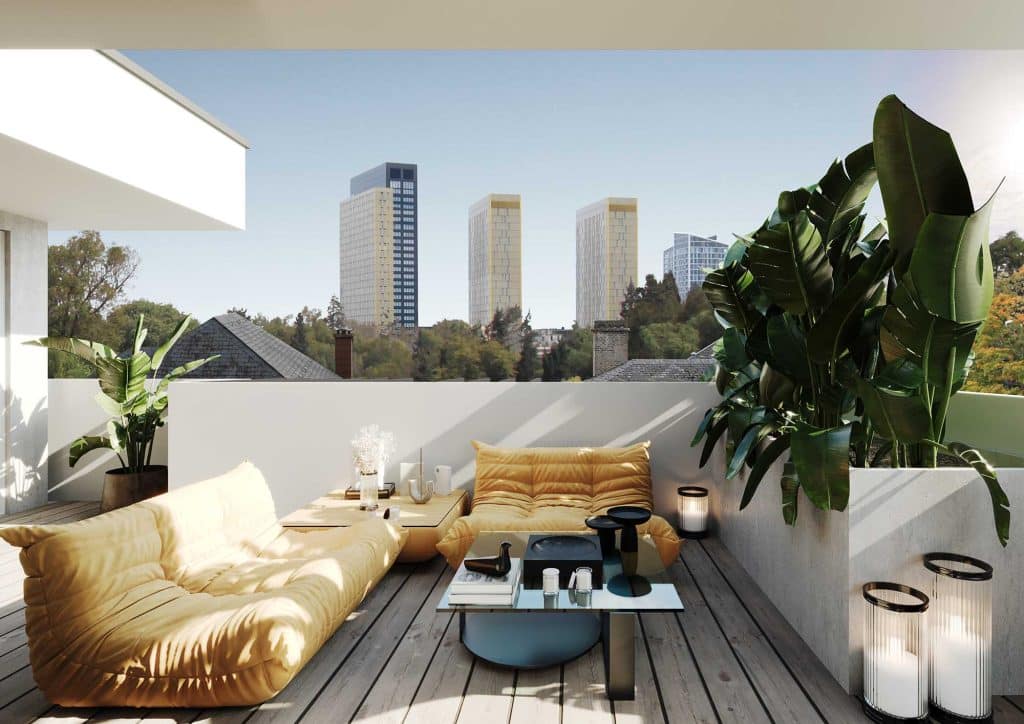
If you want to create 3D architectural images to enhance your property projects, call on the services of Banana Republic Office. We’ll bring your projects to life !
Good to know :
According to a Demandmetric study, the cost of inbound marketing is on average 62% cheaper than a traditional marketing strategy.
No need to look any further,
receive all our news in your mailbox by subscribing to our Newsletter.
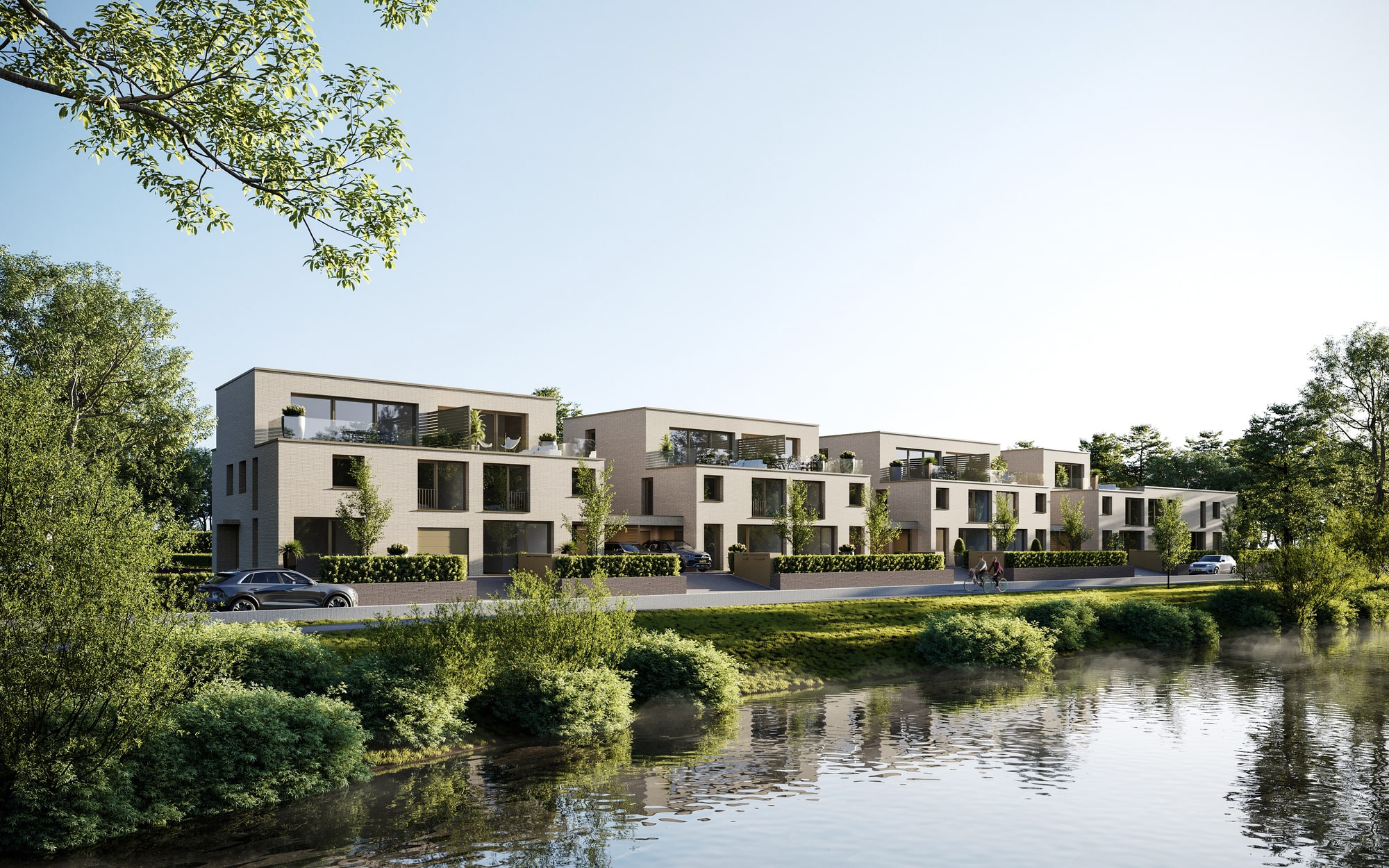
Is architectural visualization still a bit hazy for you ? Not sure what kind of renderings to expect or how to use them ? First of all, it’s a realistic representation of an architectural project before it’s completed. This representation can take many different forms. Banana Republic Office invites you to discover the 10 rendering styles possible with architectural visualization. There’s something magical about it!
Photorealistic rendering is going to make you wonder. You’ll squint at the document representing the architecture of a building or interior, and ask yourself : is it a photo ? We warned you : there’s something magical about architectural visualization.
It’s thanks to 3D perspective that you can achieve this hyperrealism, provided you’ve mastered the tools. To produce such realistic architectural renderings, you need to know the modeling tools and how to use them. A graphic designer coupled with an architect will be able to reproduce perspectives, textures, natural or artificial lighting, lifelike vegetation, and so on.
Photo-realistic rendering goes beyond conventional computer graphics. It retranscribes an atmosphere, an environment.
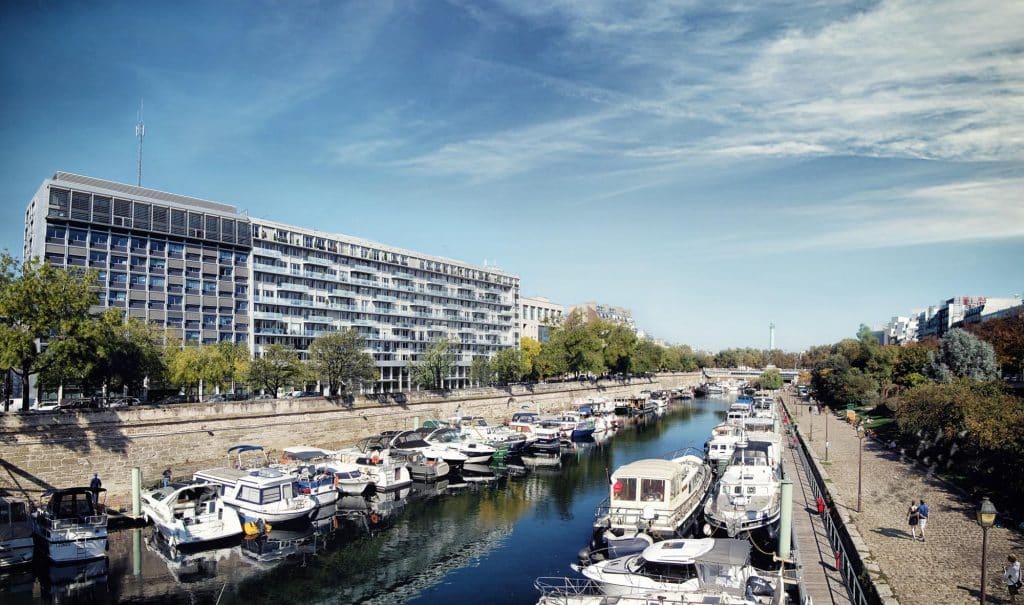
Unlike photo-realistic rendering, advertising rendering is flawless. The roughness and relief of the environment found in a realistic 3D image are smoothed out to obtain a perfect image.
Blue skies, green lawns, geometrically impeccable foliage, new furniture: everything is too good to be true. This style of architectural rendering is used to promote an architectural project on billboards, for example. Bright colors attract the eye, which is the desired effect in advertising.
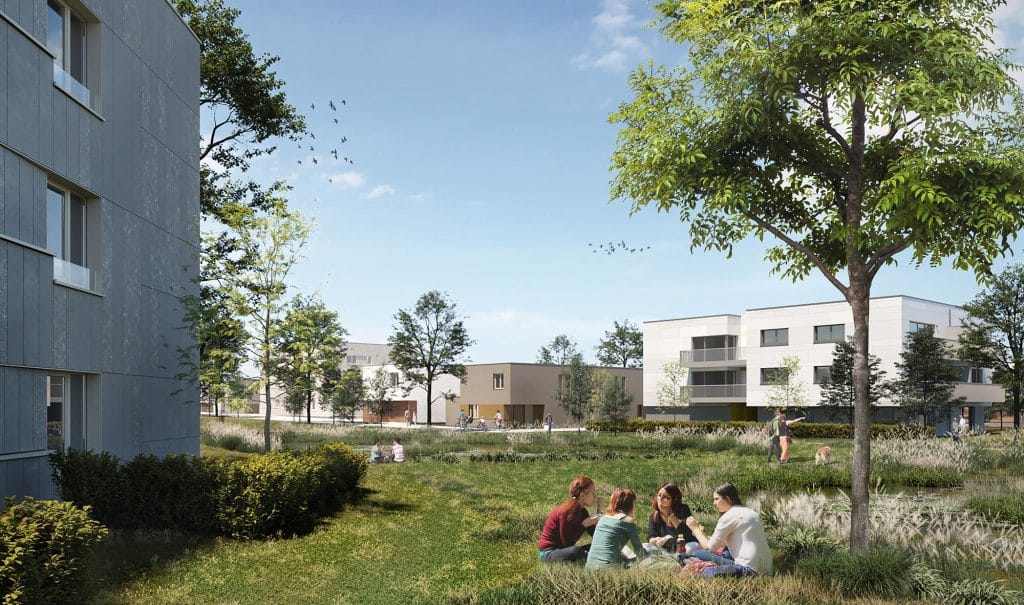
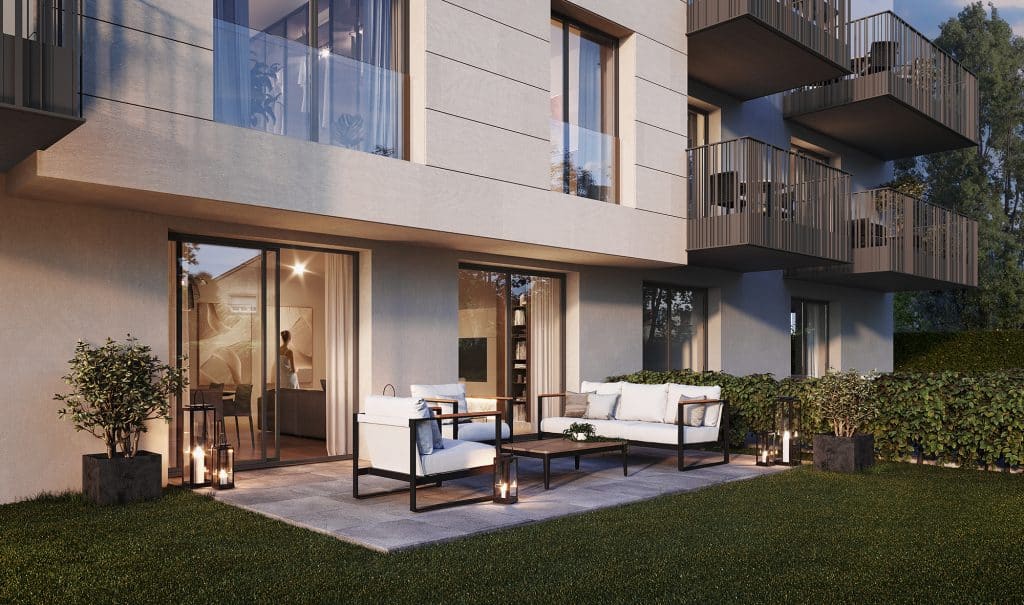
To sublimate a project and accompany a brochure with different points of view showing the surroundings or certain interior spaces, the close-up view lets you signify living situations in detail. This camera position, very close to the project, highlights the atmosphere of the users in their living environment, accentuating a terrace, a balcony, a room with its decorative elements, in order to see architectural finishing details.
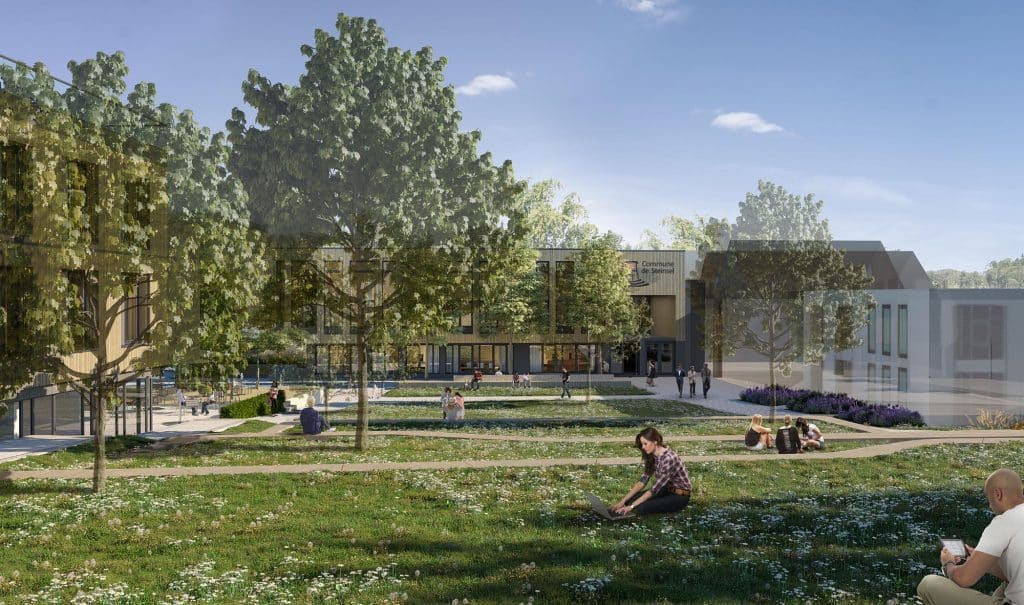
The aim of transparent architectural visualization is to place the real estate project in its future environment, making it the main actor in the scene. Trees, passers-by and vehicles are blurred or made transparent, so that the focus is on the real estate project itself. Here, the rendering is not intended to be realistic, but to highlight the project while integrating it to scale into its ecosystem.
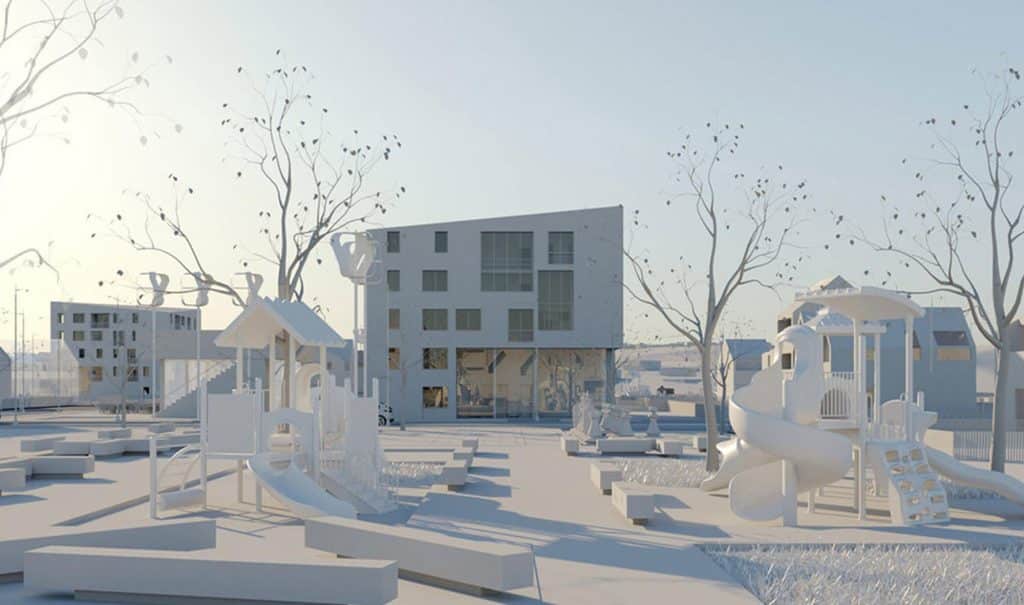
Based on white volumes, with little or no vegetation, no passers-by, no vehicles, a sky in the background, the bare minimum to begin projecting oneself into the 3D environment: nothing distracts from the architectural project, which is also intended to be minimalist. This uncluttered style is characterized by its simple lines. There’s no room for the superfluous in this architectural visualization, and it’s this controlled simplicity that makes it so valuable. This rendering, also known as Clay, provides an overall vision of the project prior to the production of a more realistic visual.
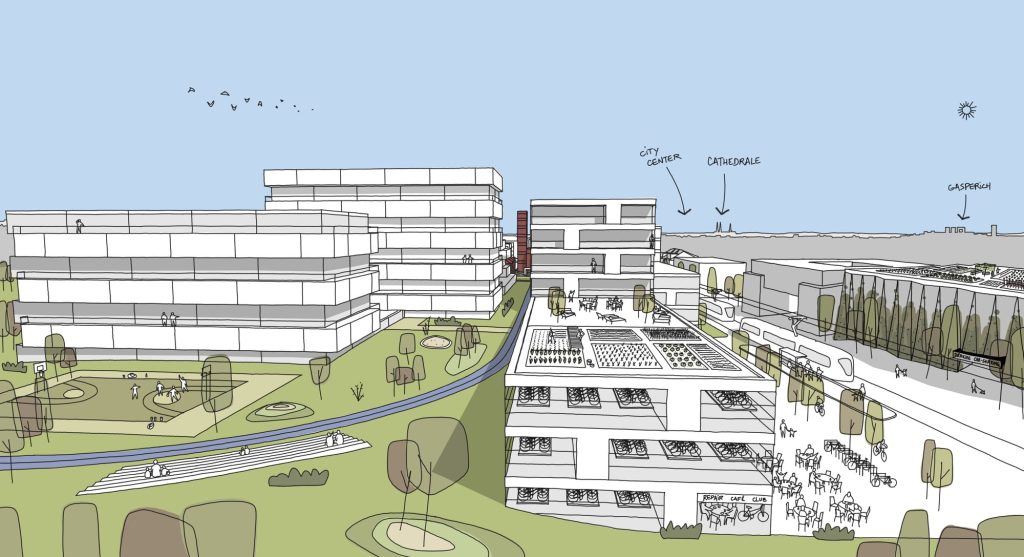
Hand-drawn to succinctly describe a concept, the sketch is linear and uncluttered, but can also incorporate color, material details or shadows. Ergonomics, functions and use are represented on the sketch.
The Sketch technique imitates the sketch. This architectural visualization can be created using black and white pencil, color watercolors, felt-tip pens or acrylics, etc… This rendering can be achieved entirely by hand, or by computer with specific software that you also need to master.
Other features of these digital tools make it possible to enhance certain aspects of the scene, such as lighting and modeling.
How do you arouse emotion when faced with an architectural project? By reproducing a real ambiance, a special artistic atmosphere that will seduce your customer. Here, it’s the heart that speaks. To pull off this master stroke, artistic flair is essential. You need to be able to find and reproduce the right atmosphere, and here styles blend together to achieve a heterogeneous result that’s a far cry from photorealism.

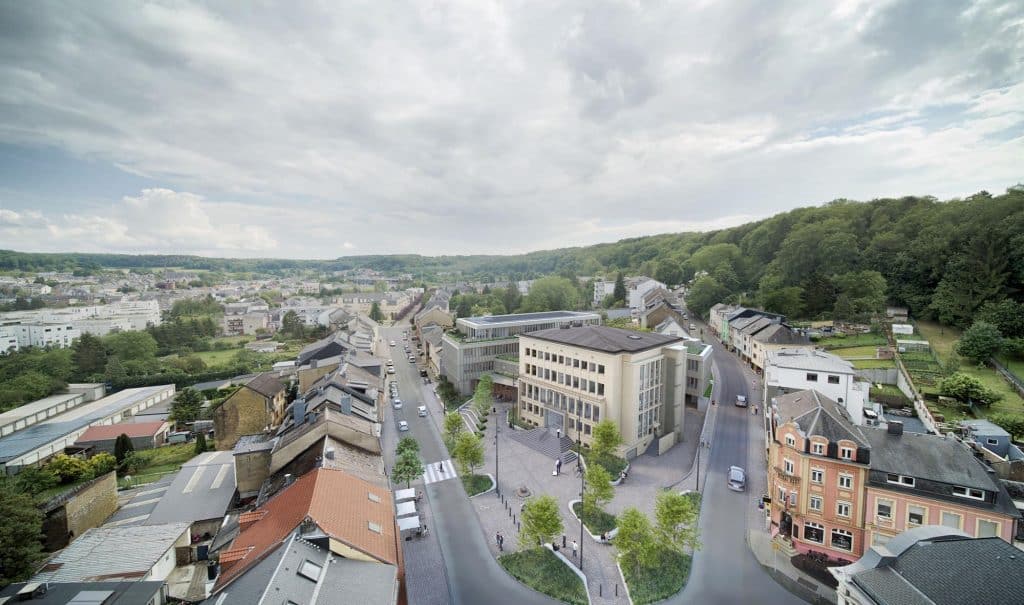
The 3D aerial view provides a complete view of a future building and its position in the environment. How is it possible to achieve such a realistic rendering ? Thanks to drone aerial photography. The 3D aerial view is the architectural visualization that lets you appreciate your project from high points. 3D perspectives are integrated into their context, whether rural or urban, on the basis of a real shot. The result is a convincing dimension and global localization.
Once again, 3D aerial imagery requires expertise and mastery of the tools used to capture images, as well as knowledge of the legislation governing drone flight. To avoid any mistakes, entrust your project to Banana Republic Office, who will take care of all the formalities for you.
Make way for movement with a 3D real estate movie. Video animation brings your project to life. You’ll discover the bustle of the neighborhood in which your project will be built, as characters move, cars move, leaves dance in the wind. It’s all real. The 3D movie is designed to introduce your customers to a real lifestyle, one that might just win them over.
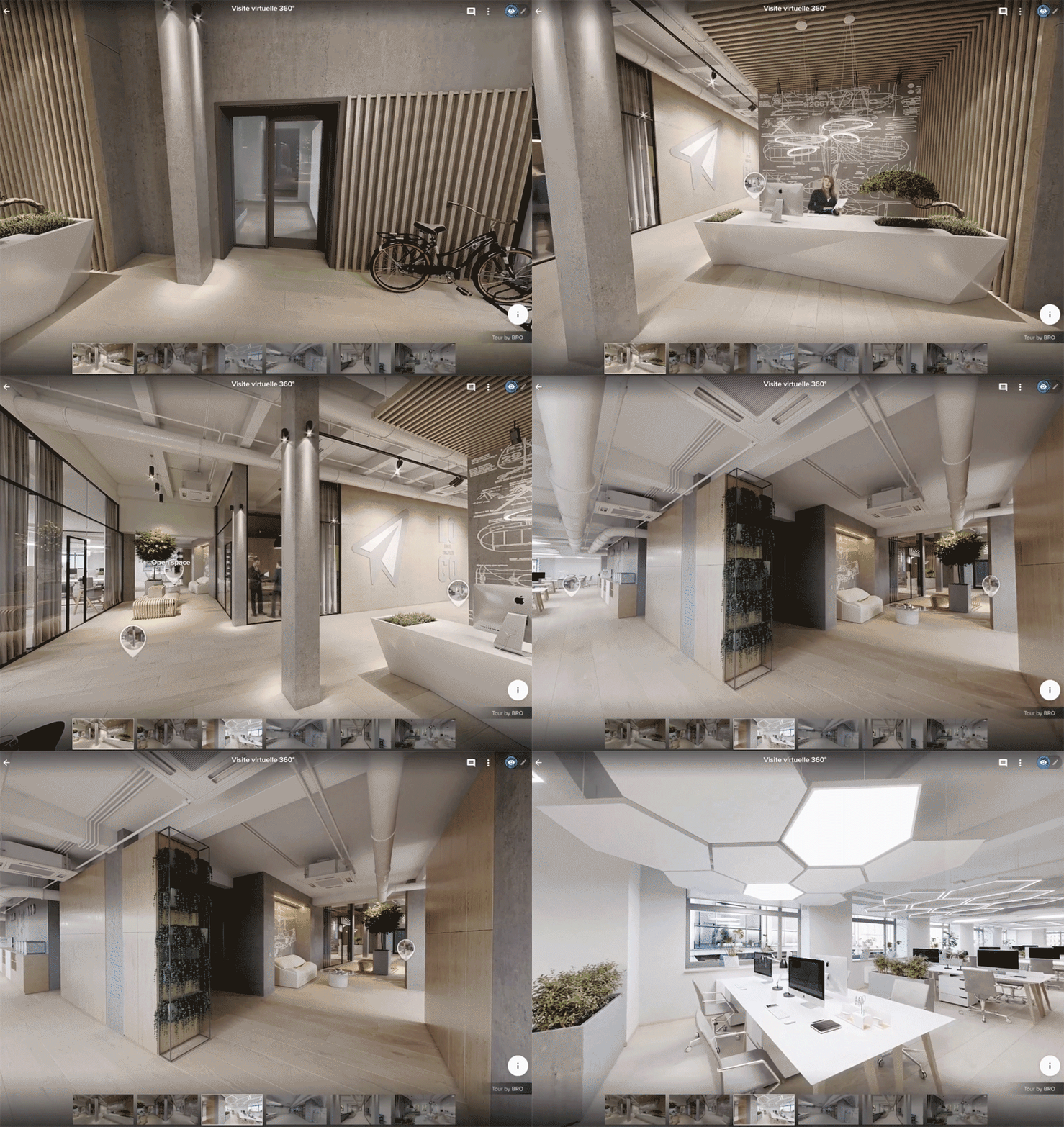
Here, it’s your customer who takes the lead and, thanks to the immersive tour, plunges into the heart of your real estate project. The 360° virtual reality tour is an interactive architectural rendering in which the customer is taken on a three-dimensional tour of their future home or apartment. It requires undeniable expertise.
At Banana Republic Office, we put all these skills at your service. Contact us and tell us about your project, and we’ll create the architectural rendering that suits you best.
Good to know :
According to a Demandmetric study, the cost of inbound marketing is on average 62% cheaper than a traditional marketing strategy.
No need to look any further,
receive all our news in your mailbox by subscribing to our Newsletter.
It is difficult to estimate the number of real estate transactions that take place worldwide each year. What is certain is that many properties are put up for rent and sale every day. Before finding a tenant or a buyer, real estate agents and brokers have their work cut out for them. The right means must be used to match the right property with the right buyer. The strategy to be adopted varies according to the type of property and the profile of the potential clients. Digital marketing is one such strategy. What is digital marketing and how can it be applied to the real estate market ? Banana Republic Office tells you everything.
With the internet, marketing opportunities are immense and valuable information such as statistics are readily available. Indeed, the benefits of digital marketing in real estate are more easily measured than those generated by traditional advertising. It is therefore easy to target a particular audience en masse and quantify the success of the operation.
Property owners do not always appreciate the added value of digital marketing tools for the rental or sale of their property (flat, house or commercial unit). Real estate agents and developers need to make the best use of these levers. Here’s how to do it.
Most (if not all) of your potential customers have a reflex to study real estate offers on the internet. That’s why it’s important to invest in your website to develop your digital marketing.
Your website is a reflection of your agency and your professionalism. Your prospects should be able to navigate it easily from any type of device (computer, tablet, smartphone). They will probably also want to filter their searches to find the perfect fit for their budget in just a few clicks.
A responsive, user-friendly, user experience (UX) website is good for customers, but also for SEO, i.e. your search engine ranking.
Social networks are a strong lever in digital marketing. You need to be present to develop your notoriety. Moreover, if all networks have a large audience, each one targets a specific category. Professionals looking for a commercial space will be more receptive on LinkedIn. The (very) young will discover real estate on Tiktok through dynamic videos that will catch their attention. Instagram will give pride of place to photos and Facebook will allow you to easily relay links to your website.
Launch a campaign via social networks and use the analysis tools to check its impact. You can then adjust your digital marketing according to prime time for example.
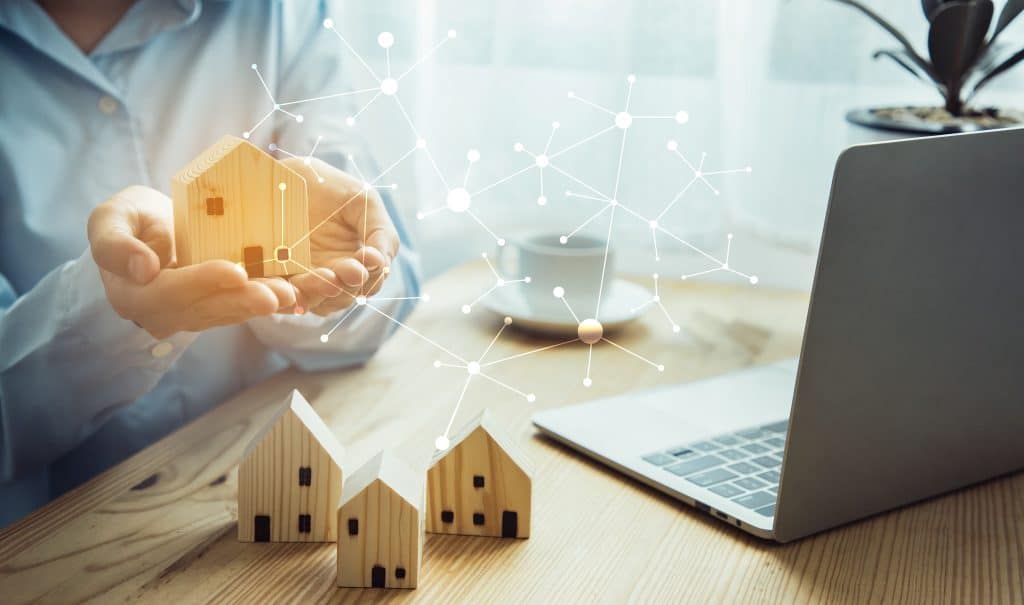
Photos and videos should be used on your website, your social networks, but also in your brochures and advertisements. It is essential to have quality images for a wow effect. 3D perspectives and 3D movies are also welcome.
To create quality visuals, don’t hesitate to delegate this part to professionals. A photographer, a professional videographer or even a 3D creation studio such as Banana Republic Office will be able to highlight your real estate.
To get and keep the best position on Google and other search engines, it is recommended to adopt an SEO (search engine optimization) strategy. You will gain quality traffic and increase the number of conversions.
You should therefore regularly add quality content to your website, with keywords, tags, internal and external linking, etc. Your articles, blog posts should be well written. As far as the real estate market is concerned, you must answer your prospects’ queries without forgetting to target the location.
If SEO seems complicated, you can delegate the content strategy to marketing and communication agencies and web writers.
In the real estate sector, there is a lot of competition. A well-established real estate marketing plan and targeted digital marketing will be your best assets to stand out. Also, don’t be afraid to be creative in order to make an impression and have a strong identity.
The digital world and digital marketing in the property market are now essential to the growth of your business. Your online presence is essential to rent, sell and promote your properties. Call on Banana Republic Office for advice on real estate development and to carry out your communication and marketing plan.
Read our article on the successful real estate marketing in 2023 !
Good to know :
According to a Demandmetric study, the cost of inbound marketing is on average 62% cheaper than a traditional marketing strategy.
No need to look any further,
receive all our news in your mailbox by subscribing to our Newsletter.
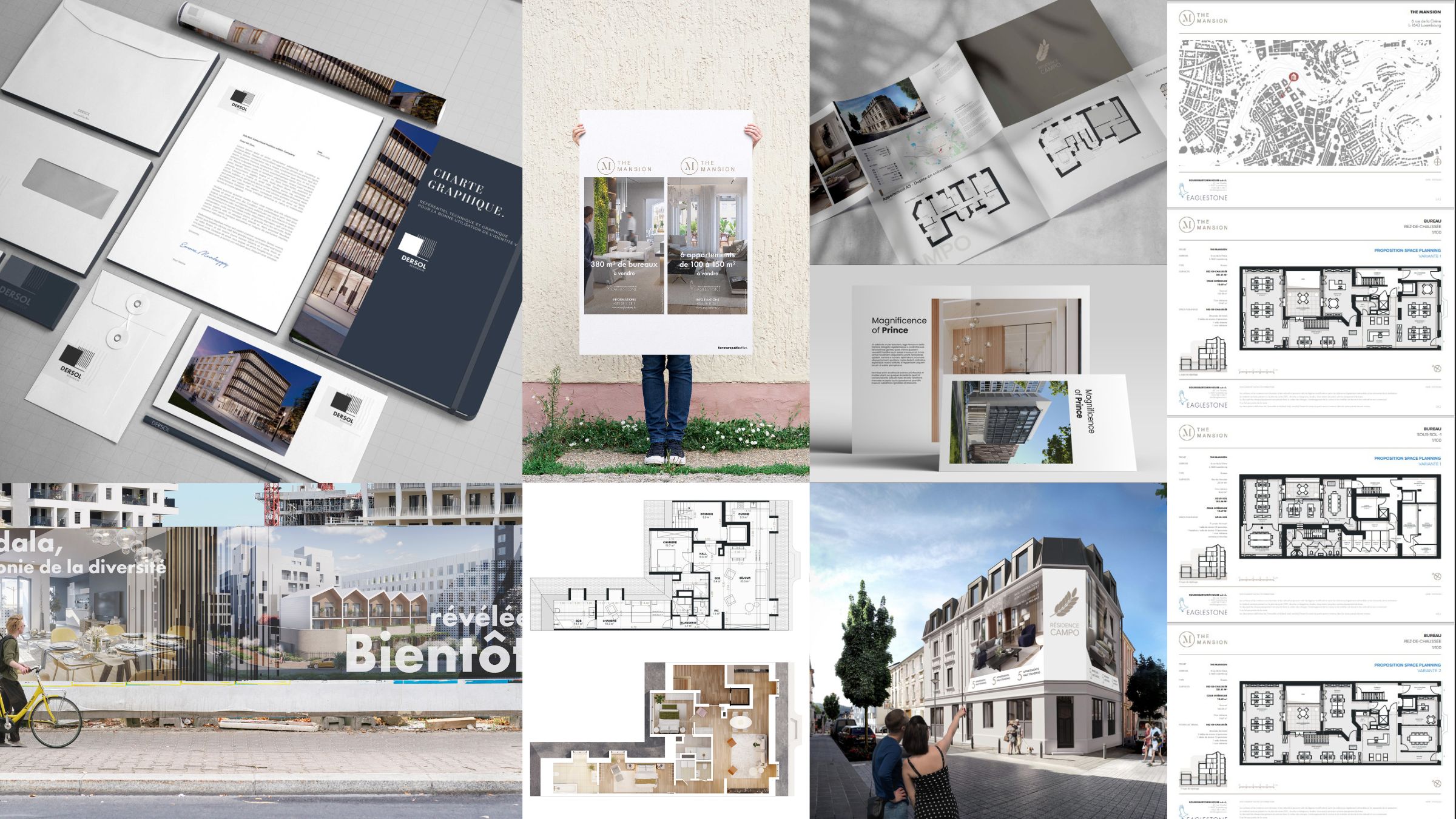
Did you know that : in 2021 the real estate sector was the one that recorded the most business registrations ? This means that the competition is getting tougher and tougher, and you need to stand out from the crowd if you want to stand out from the crowd.
In 2023, focus on your real estate marketing strategy ! This is the best way to convince more potential buyers to believe in you, by entrusting you with the project of sometimes a lifetime : becoming a homeowner. Banana Republic Office gives you some tips on how to successfully market your property in 2023.
The real estate marketing plan is a powerful tool for a successful marketing strategy. By following this method, you will be able to anticipate the needs of your customers and therefore respond to them as accurately as possible.
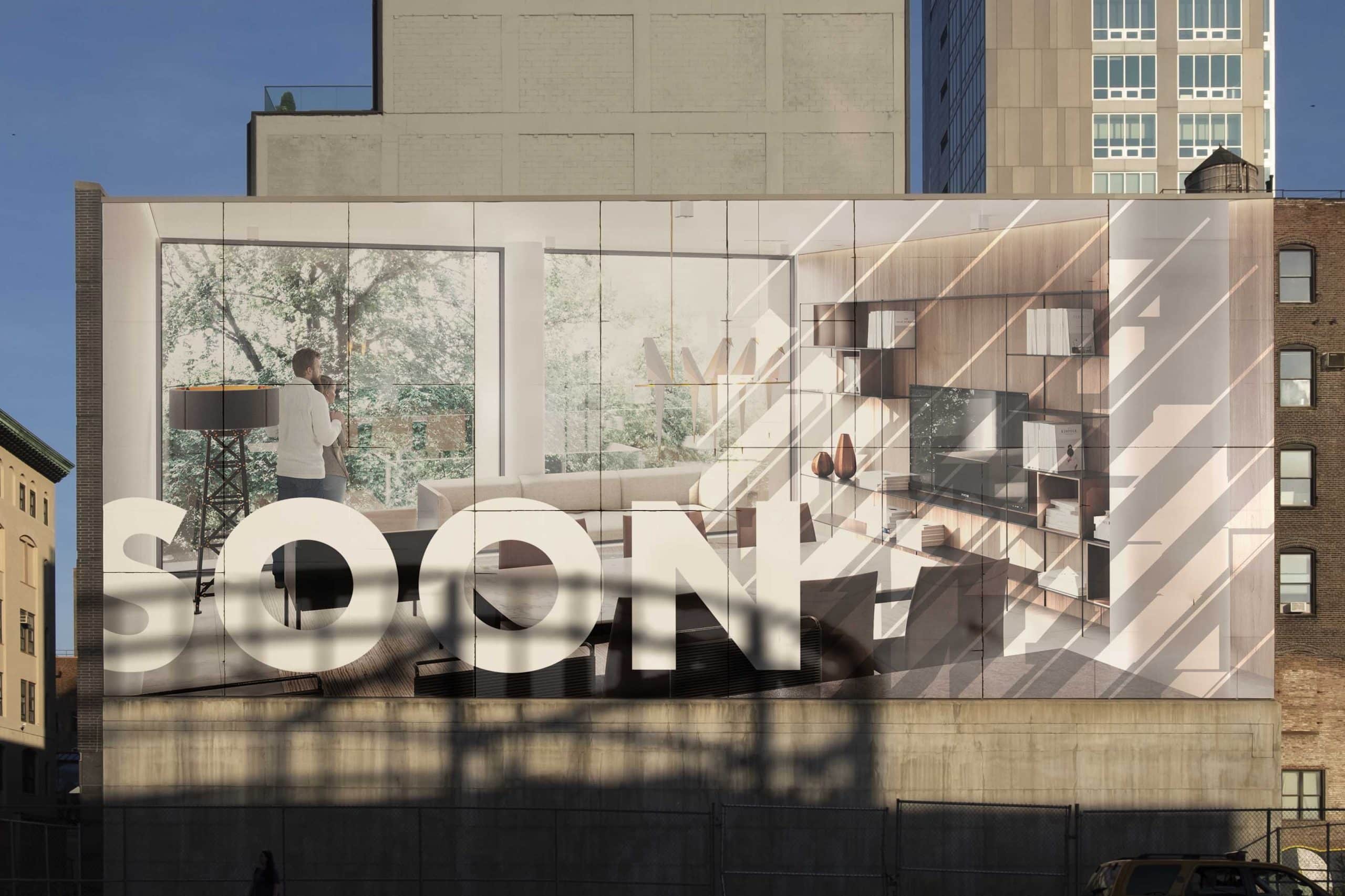
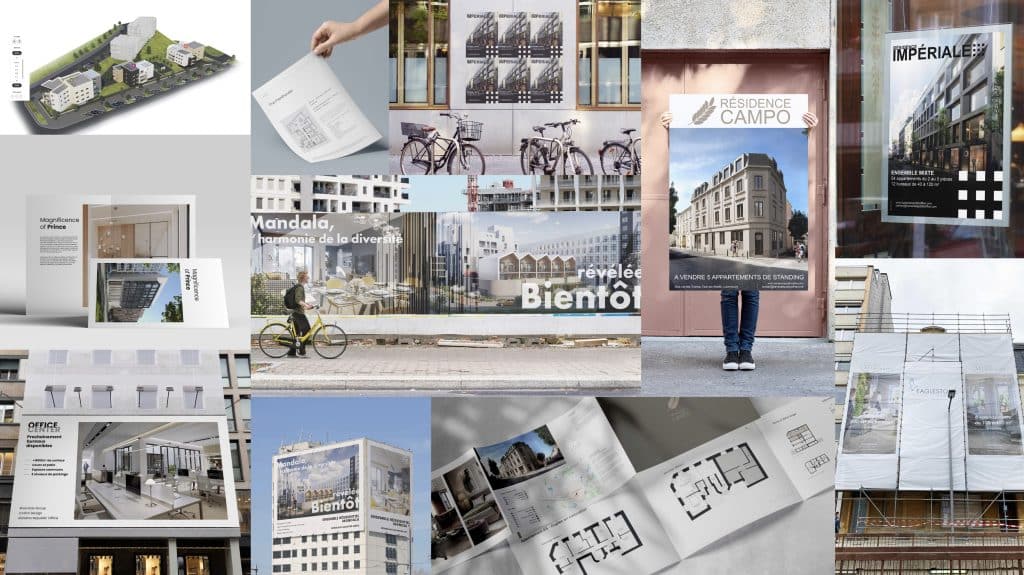
Real estate marketing and real estate marketing strategy can be deployed on different media such as your presentation brochures, your banners, your website, your newsletter or social networks. Real estate has the advantage of occupying a special place in the hearts of your prospects, so they are generally quite receptive.
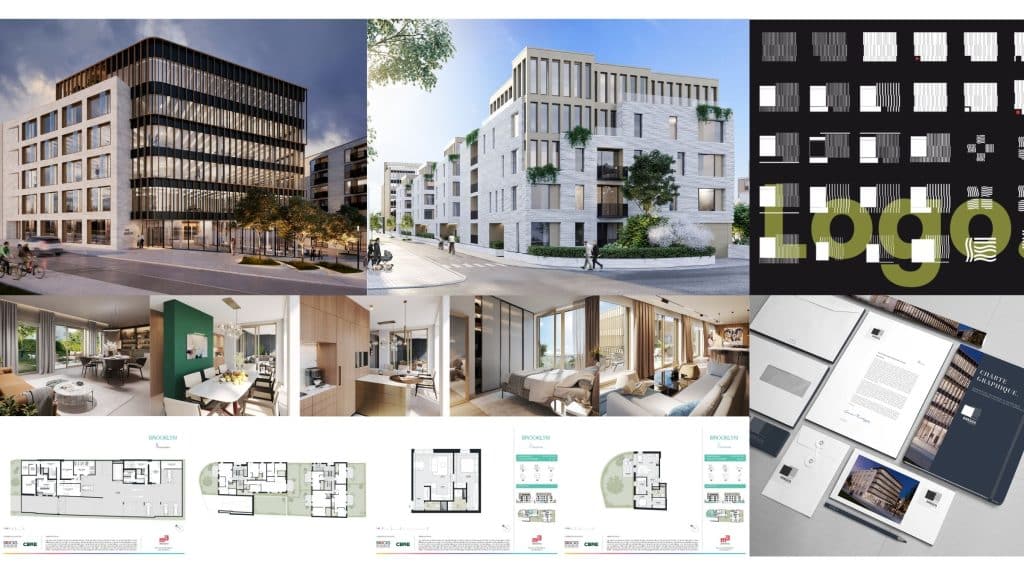
Perhaps you work for a particular audience ? Then your property marketing should be aimed at them and your pitch should be tailored to them. Personalise your message, emphasise the benefits of making the project a reality and remove any doubts !
The right message delivered via the right channel will give you the best chance of success. It is important to differentiate between the four main targets for property marketing : singles without children, couples without children, couples with children and multi-person households.
Select the category your message is aimed at and then refine the target by adding geographical, socio-cultural, behavioural, etc. criteria.
Or do you work for professionals in the sector ? In this case, adapt your strategy towards developers, investors, funds, family offices for your business. Whether it is for large or small projects, the important thing is to convince the public to follow you in your projects by showing them the reliability of your intentions, with tailor-made presentations and also assistance in developing the project.
Our company will assist you in your feasibility strategy and architectural design, as well as in real estate marketing and sales. Our teams offer you a 360° panel exclusively dedicated to the development of architectural and real estate products; residential, office, commercial; our assistance in augmented architecture is positioned from design to branding.
Now you have what we call a persona. You can now direct your message and deliver it through the channels they use, such as having influence effectiveness in meetings.
Now that you know who you’re talking to, you need to gain the trust of prospects to turn them into customers.
Branding and personal branding are marketing strategies that allow you to position your brand (or yourself in the case of personal branding) in the long term by using its reputation and by highlighting its values and your own.
You need to define your brand’s positioning in relation to the competition beforehand in order to succeed in differentiating yourself and developing your activity.
This requires a little introspection work to objectively assess the strengths and weaknesses of your business and at the same time analyse the competitors, the customer profile and the type of property and land.
If becoming a homeowner is a dream, or being an investor a profession with methodical rules, it can also become a source of stress. Your real estate marketing strategy must take into account the concerns of buyers and above all find the words to reassure them. Buying or investing in a property will be a stress-free experience thanks to your support. Don’t hesitate to put forward the positive opinions of your clients and collaborators. They are your best ambassadors, especially when you know how important online reviews are. If they value the quality of your support, your services and your expertise, this reassures future customers.
What is the first reflex of 2.0 customers ? Search the internet. Your real estate marketing strategy must go through this. You must absolutely take care of and optimize your visibility on the web.
Multiply your presence by creating a listing on Google (formerly Google My Business) and by targeting local customers. Real estate portals are essential, as are social networks. Don’t neglect natural referencing and use keywords, it’s your shop window.
The Internet is good, but you must not neglect your presence on the ground. Real estate remains a local service. Your presence in your catchment area must be noticed. When your potential customers are considering a real estate project, they will know who to turn to because they will already know you.
Real estate marketing on the ground in 2023 has not changed from previous years. It consists of distributing flyers, brochures, putting up signs on the properties you have been entrusted to sell, having a shop window and a real presence.
You now have all the keys to a successful property marketing strategy in 2023. To go further, discover the benefits of communication and marketing in real estate.
Don’t want to miss our news? Don’t forget to subscribe to our newsletter.
Read our article on the benefits of communication and marketing in real estate
Good to know :
According to a Demandmetric study, the cost of inbound marketing is on average 62% cheaper than a traditional marketing strategy.
No need to look any further,
receive all our news in your mailbox by subscribing to our Newsletter.
As you already know, to save time in real estate you need to rely on good communication. Indeed, the advantages of communication and marketing in real estate are numerous and make it possible to reduce the sales period. But in the beginning, there is an indispensable tool: the marketing plan. Having an effective real estate marketing plan means knowing how to position yourself, define your objectives, implement a strategy, find the right tactics and measure the results. Banana Republic Office gives you its advice and offers you to discover some figures proving that digital marketing improves the sale and the market absorption time.
“Know your enemy and know yourself”, said Sun Tzu in The Art of War. Knowing your positioning and how potential customers perceive you is an essential first step to being able to differentiate yourself from the competition (of which there are many in real estate).
Start by taking stock, analysing your strengths and weaknesses and doing the same with those of your competitors. Start with your current customers and define your target (expectations, needs, satisfaction and dissatisfaction). Identify your growth opportunities. What new markets are open to you? What are the consumer trends? Don’t forget to take into account the potential obstacles, whether economic, legal, etc.
By considering all these elements, you will be able to define your positioning and find areas of differentiation that will encourage your customers to choose you.

Ask yourself what the ideal results would be once the property marketing plan is in place. These are your goals. Keep in mind, however, that your goals must be realistic and achievable. Setting unattainable goals is counterproductive. Also make sure that your entire team accepts this new property marketing strategy.
Your goals may include a new target, meeting a specific timetable, getting the resources you need for your development in terms of materials, staff and service providers. Don’t neglect the marketing budget, which should include all costs and the forecasted number of property sales or mandates.
Be careful not to spread yourself too thin. The trick is to set a global strategy with a triple objective. For example, your digital strategy may have three objectives
1) increase traffic to your website
2) reach new customers;
3) facilitate prospecting = improve sales.
Now that you know the objectives and the target audience, it is time to set up the real estate marketing strategy. It is essential to plan your marketing actions and to make your tools profitable.
Internet marketing strategy differs from traditional marketing strategy in that it is about getting customers to come to you instead of going out to find them. Indeed, many consumers have the reflex “internet” before buying. This is called inbound marketing.
Inbound marketing is about attracting all kinds of people, turning them into prospects, then into customers and the (best) ambassadors of your company.
Since they come to you and not you who go looking for them without their consent, potential customers are less suspicious and more confident. This makes it easier to create engagement, prove your expertise and increase your brand awareness.
Good to know :
According to a Demandmetric study, the cost of inbound marketing is on average 62% cheaper than a traditional marketing strategy.
Defining the objectives and the strategy: that’s done. Now what are the concrete actions to implement ? Some web marketing tools are effective in real estate to get new prospects and leads. You may already have these tools, you just need to optimise them. These include your real estate website, your professional blog, your ad portal, your emailings and newsletters, your social networks.
There can be many marketing media in real estate, both print and digital, the advantage is that they can be exploited in different ways depending on the location, exposure and target.
It is essential to create quality content that will not only attract, but also convince your customers, encourage them to take action and build loyalty.
While awareness is not always easily measurable, key performance indicators, also known as KPIs, are essential for measuring the success of real estate marketing campaigns and for establishing areas for improvement.
These include:
Beyond these data, you should also be able to measure your results via the increase in the number of mandates or real estate sales and your turnover.
What better way to show you the effectiveness of a real estate marketing plan than with figures? Here are a few figures.
64% of users of social platforms make purchases (source: Accenture).
95% of real estate transactions are online, 46% organic traffic, 37% direct traffic (Source: Desktop).
47% of online visitors are between 25 and 44 years old. Women represent the majority of visitors (59%).
62% of visits are made via smartphone.
Read our article on the benefits of communication and marketing in real estate
No need to look any further,
receive all our news in your mailbox by subscribing to our Newsletter.


